
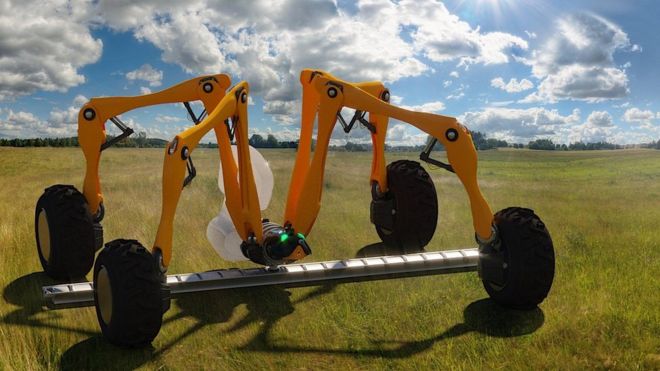
The company behind them has devised a set of rules about how they behave, one it hopes others may adopt.
Mainly the rules refer to how robots need to serve humans but does one give them a glimpse of their own rights?
On this week's we discuss what the blueprints for human/machine interaction should look like.
he little farming robots do not come across many humans, other than the odd rambler, Ben Scott-Robinson, co-founder of the Small Robot Company, told us.
But he still thinks the time is ripe to discuss how we want to interact with machines in future.
"We're about to see a massive influx of commercial robots in the consumer domain. In our shops, our factories, our hotels, our streets and our fields. It's vital that consumers can trust and feel comfortable with these encounters," he said.
The rules build on those created by science fiction writer Isaac Asimov in his 1942 short story Runaround, where he decreed that an autonomous machine must not harm a person, always obey orders and protect its own existence without compromising its other principles.
The new blueprints include these rules:
- The human user will always have ultimate control
- If a robot is disconnected from the user, it will stop
- A user is responsible if the robot goes wrong
But one of the rules hints at the potential need to give the robots themselves some rights:
- A robot has the right to react if it believes an interactor is behaving maliciously
Mr Scott-Robinson told us this was not as revolutionary as it might sound: "It's much more mundane. It is the same as if someone maliciously interferes with your car then the alarm goes off. If someone picks up or kicks a robot when it is going about its daily work, then the robot should be able to collect information about who is doing it and tell its user."


Hakuna maoni:
Chapisha Maoni